


Stefanos Tsitsipas has continued his resurgent start to the 2025 season after beating Matteo Berrettini to reach the fourth round of Indian Wells.
Tsitsipas won the Dubai Tennis Championships prior to heading to California, that confirmed his entry back into the top ten of the ATP rankings.
There was a notable difference in the Greek’s equipment in Dubai, with Tsitsipas switching his racket to great success.
This is not the only change that he has tried to make, with Tsitsipas also working on particular shots to help him get back to his previous heights.
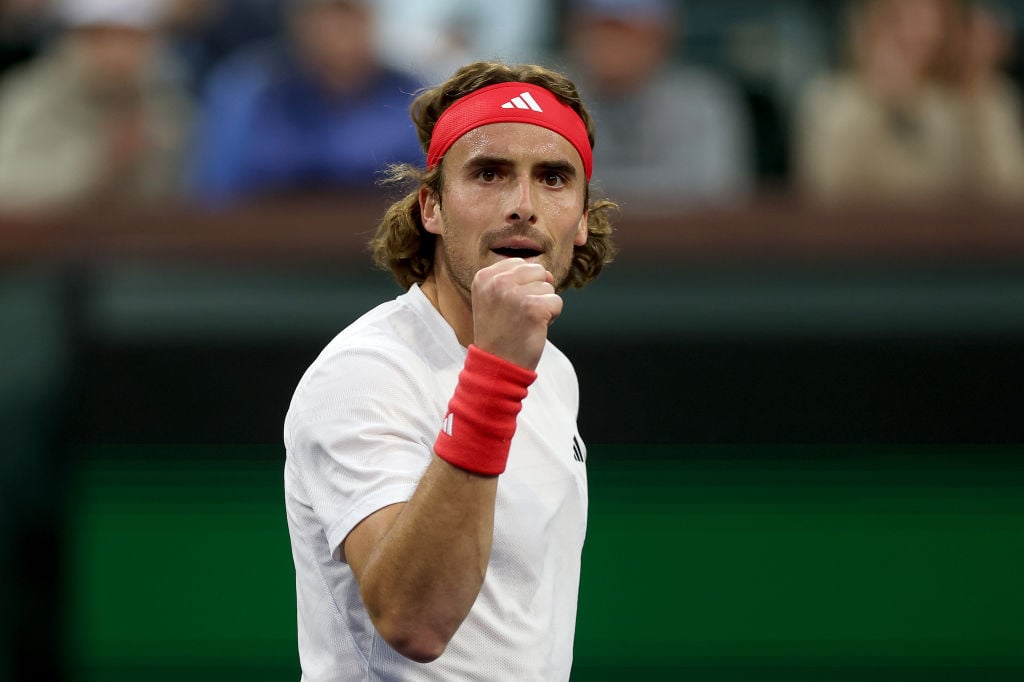
Stefanos Tsitsipas names the two perfect matches he has played
Tsitsipas is a former world number three and has reached two Grand Slam finals at the Australian Open and Roland Garros.
However, in recent years Tsitsipas has struggled to live up to the previous hype that he has created for himself and has only won one of his last four Grand Slam matches.
After being beaten, 6-3 6-3, former Wimbledon finalist Berrettini said that Tsitsipas played the perfect match.
While Tsitsipas was not so sure that was the case, the 26-year-old did name the two matches that he thinks would fit that bill.
Both of those came at the Australian Open, including Tsitsipas’ first match against Roger Federer at the 2019 tournament where he won in four sets.
The other match Tsitsipas named was against Rafael Nadal, where he came from two sets to love down to beat the Spaniard in the 2021 Australian Open quarter-finals.
“Two perfect matches that I have played,” began Tsitsipas in his post-match press conference. “It’s an interesting one, because I’ve had a bad start against Rafael Nadal at the quarterfinals of the Australian Open. It was not great. I remember thinking to myself, I’m not playing well.
“I lost the first two sets, and I think something just clicked. I just started, you know, jumping around a little bit more. I felt I was waiting too long when he was serving, and I felt like I couldn’t get into the rhythm of the match. So I tried to try a few things that could help me out, get into the rhythm.
“And I feel that since that moment, being two sets to love down until the very end, I kind of peaked and reached almost perfect tennis and ended up winning the match.
“It still remains one of those moments I’m really proud of because I felt like my tennis instantly just changed. I would call it a semi-perfect match, let’s call it (smiling).”
Tsitsipas continued, “Another one was probably against Roger Federer, again at the Australian Open, because of, first of all, the player that he is. Someone that, you know, I had massive respect for, and he was my childhood hero. So playing him first time at a slam was not easy to deal with. I felt like players at my age during that period, it wouldn’t have been as easy.
“But I was determined when I entered the court. I’m like, I’m not leaving unless there’s something to learn from this experience, and I really want to go all the way in that match. I’m not going to let him win just because he’s Roger Federer, and I managed to win that match.
“I played perfect tennis, even though I was dealing with a lot of pressure moments in that match. Wasn’t serving amazing, but made it work somehow. I would just say that my composure and my inner strength in those moments were the factors that made me prevail at the end.”
Stefanos Tsitsipas says that the Indian Wells courts remind him of clay
The Indian Wells courts have been a big conversation this year, after the tournament changed their manufacturer for the first time in 25 years.
Tsitsipas has adapted to the Indian Wells conditions, explaining after the match that they play a lot like clay courts that he is very familiar with.
“I grew up playing clay courts, so for me this is quite normal,” said Tsitsipas. “I’ve played my entire life with bounces like this. But I have to agree that, yeah, the bounce is unusual for hard court. You don’t see that when you play hard courts.
“I came from a tournament last week where the ball was skidding more throughout the court and wasn’t as bouncy. It takes a few days to adjust to that, because your ball-eye coordination is a specific kind of way, and now you have to kind of readjust and reconfigure yourself to match those speeds, and perhaps sometimes you are too early. I don’t have that very often that I’m too early to the shot or to the ball.
“I feel like it kind of stops sometimes. It doesn’t really go through the court. But it reminds me a lot of clay. Like it literally feels like a clay-court version of hard, yeah.”
Tsitsipas will look to continue his seven match winning streak when he plays world number 13 Holger Rune for a place in the Indian Wells quarter-finals.
Receive exclusive tennis news and updates twice a week to your mailbox