


Tennis was all change ahead of the 2018 Australian Open thanks to introductions decided by the Grand Slam Board (GSB).
There was plenty of excitement heading into the tournament, with star quality expected across the men’s and women’s events.
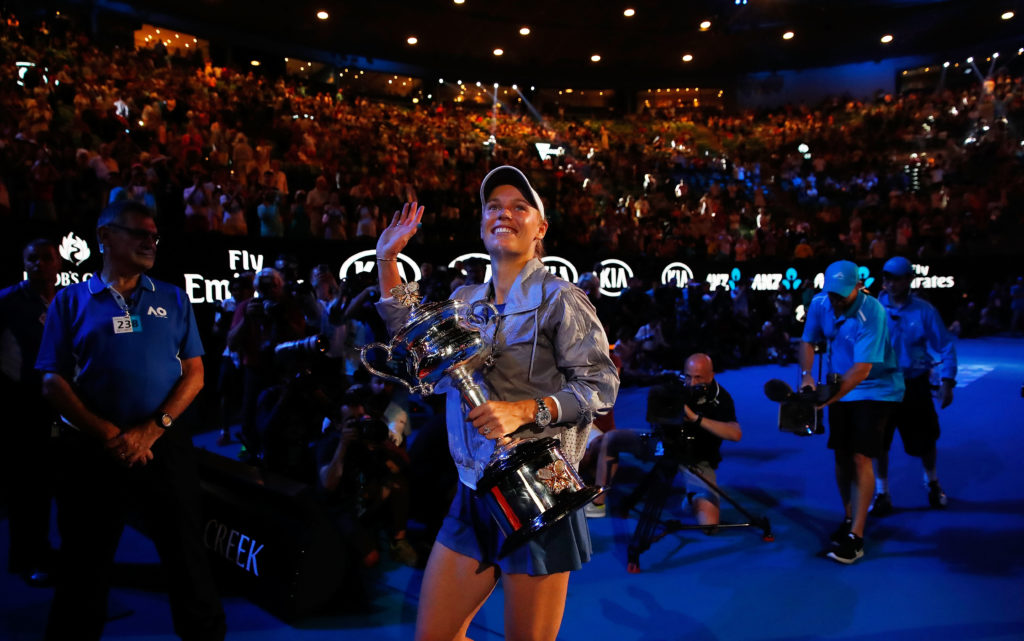
The women’s event certainly didn’t disappoint in the end, with top two seeds Simona Halep and Caroline Wozniacki reaching the 2018 Australian Open final.
In the men’s singles draw, the Big Three of Novak Djokovic, Rafael Nadal and Roger Federer were all involved.
But much of the attention before the tournament was dominated by the 25-second shot clock, which had been trialled at the Next Gen ATP Finals shortly before.
Rafael Nadal once shared concerns about the shot clock rule
The shot clock was set to count down in between points to ensure players hit their serves within the 25-second limit.
But as quoted by BBC Sport, iconic figure Nadal had his reservations in 2017, saying: “I believe it is not something that is good for the future of the Tour.
“For me personally, I am not worried at all. I don’t want to play for 10 more years. I can adapt easily to that.
“But in my opinion, it’s not the same playing at 15 degrees [Celsius] or 18 degrees than playing at 35 degrees and that’s why we have umpires, as they have to evaluate all the conditions to create the best show possible for the fans.
“In my opinion, having a clock with 25 seconds playing in some extreme conditions you cannot have the best show possible.”
Which American man has the best chance of winning a Grand Slam in 2026?

The dilemma with the shot clock in tennis
The proposal from the Australian Open was supported by all of the Grand Slams, but Nadal clearly wasn’t a fan.
It was a subtle but significant change, which like many rule changes or introductions was never going to please everyone.
Of course, different players have different paces of play when it comes to serving, with Nadal having undoubtedly been among the slower players.
His fellow legend Djokovic is arguably in the same category, with several ball tosses and bounces adding more and more time to the serve.
Who will be the biggest disappointment at the 2026 Australian Open?

A quicker turnaround in between points is arguably better for fans in attendance and indeed those watching from home, with slow speeds definitely decreasing the drama.
But as Nadal alluded to, the quality of tennis could decline, with many players certain to drop their levels if forced to rush in such a key area of the game.
Incidentally, the Spaniard ended up retiring hurt in his 2018 Australian Open quarterfinal clash with Marin Cilic, with Federer beating the Croatian in the final.
Receive exclusive tennis news and updates twice a week to your mailbox