
Novak Djokovic was made to work incredibly hard for his place in the Shanghai Masters quarterfinals
After Djokovic battled through in three sets against Yannick Hanfmann, he returned to the court to play Spain’s Jaume Munar on Tuesday.
Played in the extreme Shanghai heat, Djokovic and Munar gave it their all in front of the Chinese fans.
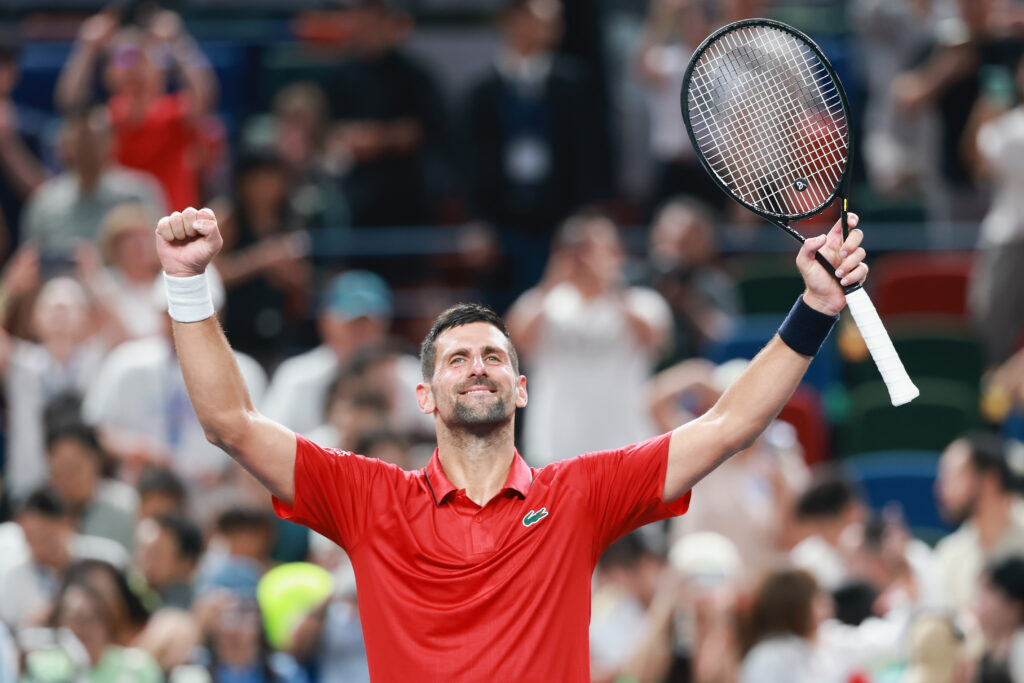
Eventually, after three sets of thrilling back-and-forth action, Djokovic defeated Munar, 6-3, 5-7, 6-2, to secure his spot in the quarterfinals of the Shanghai Masters.
The match will, however, likely be best remembered for what happened at the end of the second set…
Tennis must implement heat rules after ‘dangerous’ scenes during Novak Djokovic vs Jaume Munar
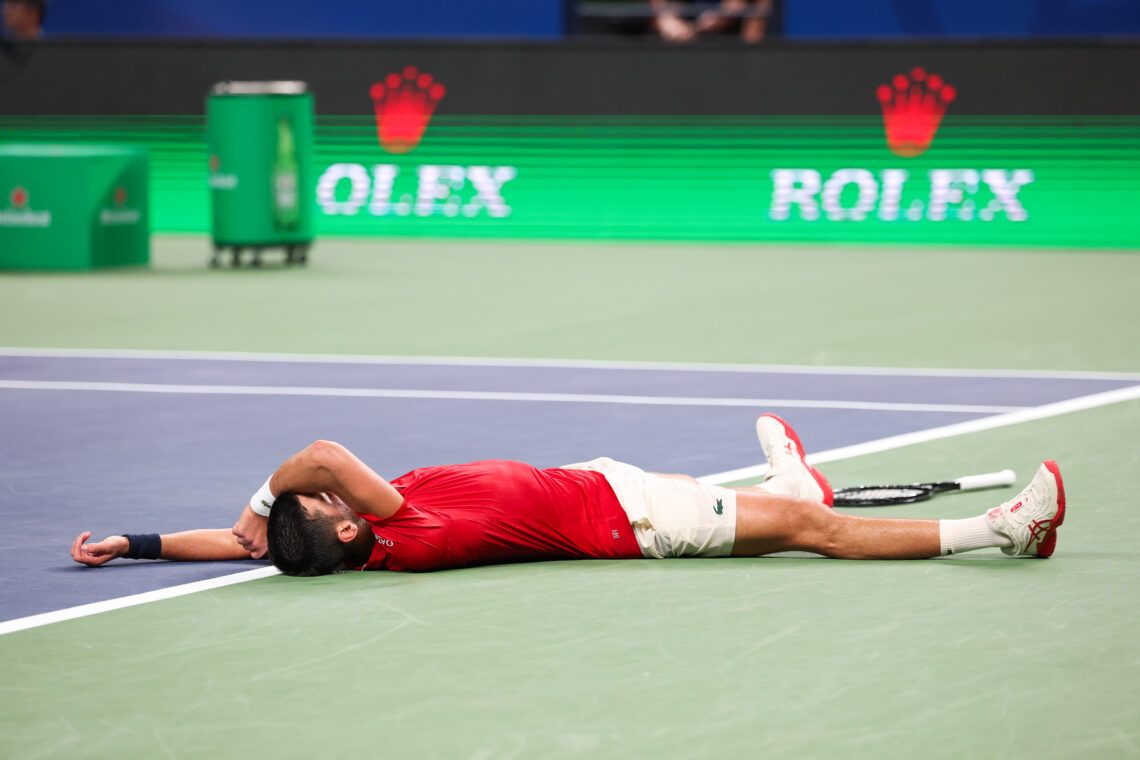
When Munar broke Djokovic to take the second set 7-5, the Serb dropped to the floor in exhaustion.
Remaining seated for over a minute, Djokovic was eventually helped to his chair by tournament officials.
The medical team proceeded to check the 24-time Grand Slam winner’s heart rate, as he looked set to retire from the match.
Reacting to the worrying scenes on Shanghai’s Centre Court, former American star Ryan Harrison said this on Sky Sports.
“When that point of exhaustion hits and you can barely hold yourself up, as was happening in that last game, it becomes actually dangerous,” he said.
“Because of your heart rate and the way your body is pumping blood, it gets to the point where you have to think about long-term health.”
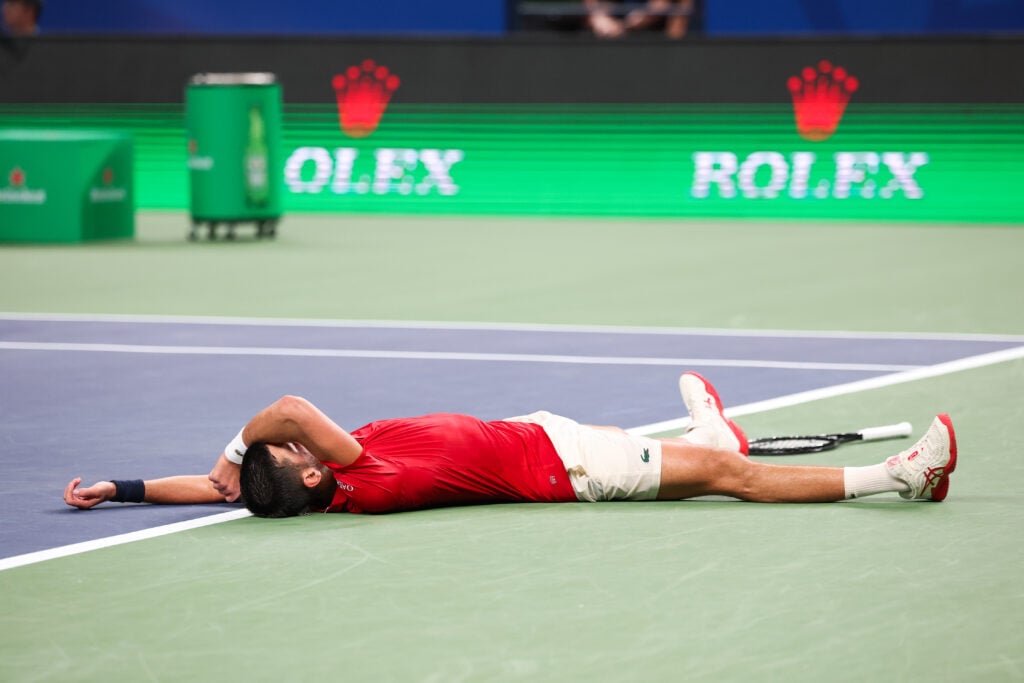
After struggling with an ankle issue in the first set, Djokovic battled the heat in the second.
Djokovic, like many other players this week, suffered from the humid conditions at the Shanghai Masters.
Seeing the Serb require medical attention should come as a warning sign for the ATP Tour, as nobody wants to see players put their health at risk.
Introducing a heat rule like they have at the Australian Open could allow players to compete safely regardless of the conditions.
Such a change could make sense, but how exactly does the Australian Open heat rule work?
The Australian Open heat rule explained
Event organizers look to the Australian Open Heat Stress Scale to decide whether a match should be delayed.
The scale ranges from 1-5, with changes implemented as the heat increases.
- 1. Temperate playing conditions
- 2. Increase hydration
- 3. Apply cooling strategies
- 4. Extended break
- 5. Suspension of play
Four different ‘heat’ measures contribute to the scale: Radiant heat, humidity, wind speed, and air temperature.
Djokovic may well have benefited from an ‘extended break’ or a ‘suspension of play’ during his fourth-round match in Shanghai, but what have his fellow ATP stars had to say?
Holger Rune calls for heat rule in Shanghai
After Rune beat Giovanni Mpetshi Perricard in his latest match in Shanghai, he suggested that the event should introduce heat rules.
“I think there should be a heat rule like there is at the Grand Slams. I think every player would agree on that,” he said.
“I think there should be some kind of rule. We can handle a certain amount of heat because we are fit, we’re strong, we’re mentally strong as well, but there’s always a limit.
“We need to survive. I think some kind of rule, you know, not that we should stop, but like the Grand Slam, you know, they have a feeling on when it’s a little bit too much, and we wait a little bit to see if it drops.”
Whether a heat rule is implemented remains to be seen, but it’s certainly something tournament organizers should consider.
For Rune and Djokovic, their eyes must now turn to the quarterfinals, as they look to set up an exciting semifinal clash.
Who will Novak Djokovic and Holger Rune play in the Shanghai quarterfinals?
Next up for Djokovic is Belgian star Zizou Bergs, who battled past Gabriel Diallo in a third-set tiebreaker in his fourth-round match.
The pair have never met before on the ATP Tour, although interestingly, Djokovic has a winning 17-8 record against Belgian opponents throughout his career.
Rune, on the other hand, will play either Tallon Griekspoor or Valentin Vacherot in the quarters.
The Dane is 1-2 against Griekspoor, but has yet to play Monaco’s Vacherot in a professional match.
Should both Djokovic and Rune advance, they would meet for a seventh time in the semis.
| Match | Winner | Loser | Score |
| 2024 Wimbledon – 4R | Novak Djokovic | Holger Rune | 6-3, 6-4, 6-2 |
| 2023 ATP Finals – RR | Novak Djokovic | Holger Rune | 7-6, 6-7, 6-3 |
| 2023 Paris Masters – QF | Novak Djokovic | Holger Rune | 7-5, 6-7, 6-4 |
| 2023 Italian Open – QF | Holger Rune | Novak Djokovic | 6-2, 4-6, 6-2 |
| 2022 Paris Masters – F | Holger Rune | Novak Djokovic | 3-6, 6-3, 7-5 |
| 2021 US Open – 1R | Novak Djokovic | Holger Rune | 6-1, 6-7, 6-2, 6-1 |
Fans would no doubt love to see the pair face off for a place in the Shanghai final, but the players won’t want to get too far ahead of themselves.
Djokovic will first focus on getting past Bergs, and Rune will try to beat Vacherot or Griekspoor on Wednesday, October 8.
Receive exclusive tennis news and updates twice a week to your mailbox