
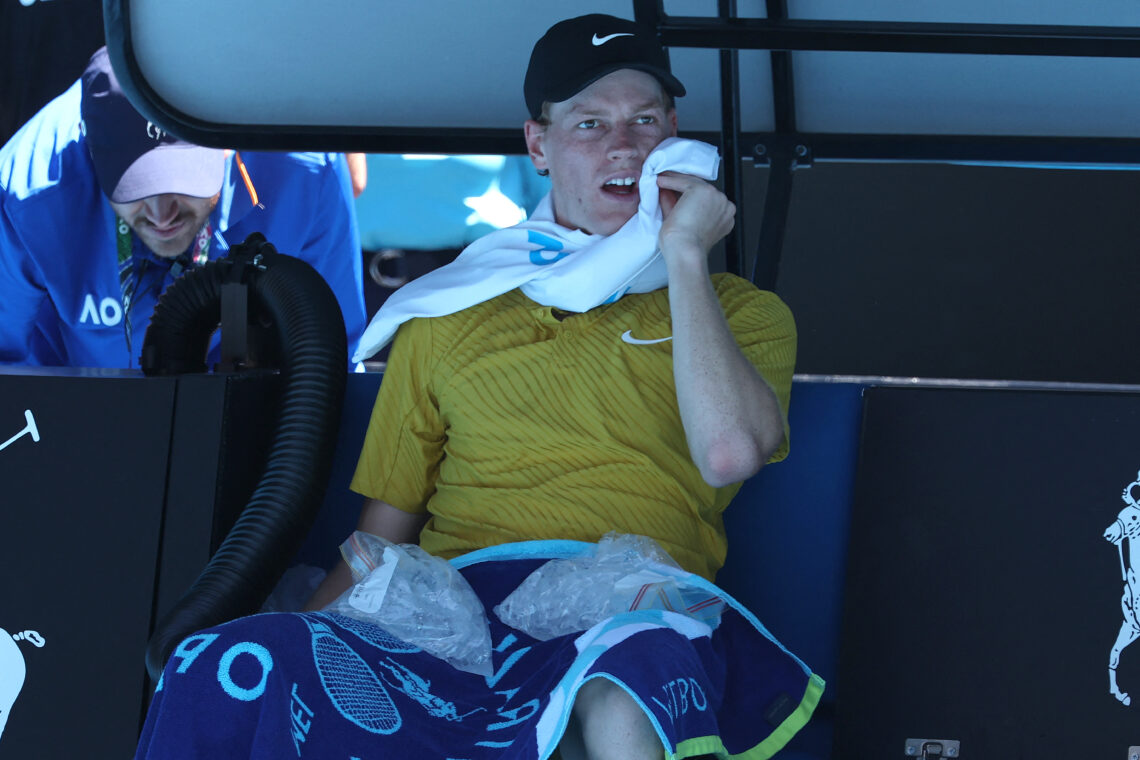

Jannik Sinner has created a big debate following a controversial moment during his latest match at the Australian Open.
Sinner struggled in the extreme heat during his third round match against American Eliot Spizzirri, with temperatures reaching 38 degrees Celsius (100 degrees Fahrenheit) in Melbourne.
However, after trailing 3-1 in the third set, Sinner was able to leave the court as the heat rule came into play and enabled the roof to be closed on Rod Laver Arena, before the world number two fought back to win the match in four sets.
The timing of this decision has split opinion, with Martina Navratilova claiming the Australian Open made a mistake relating to Sinner.
As the conversation about the incident continues, former top 30 player Steve Johnson has called for tennis to make a rule change.
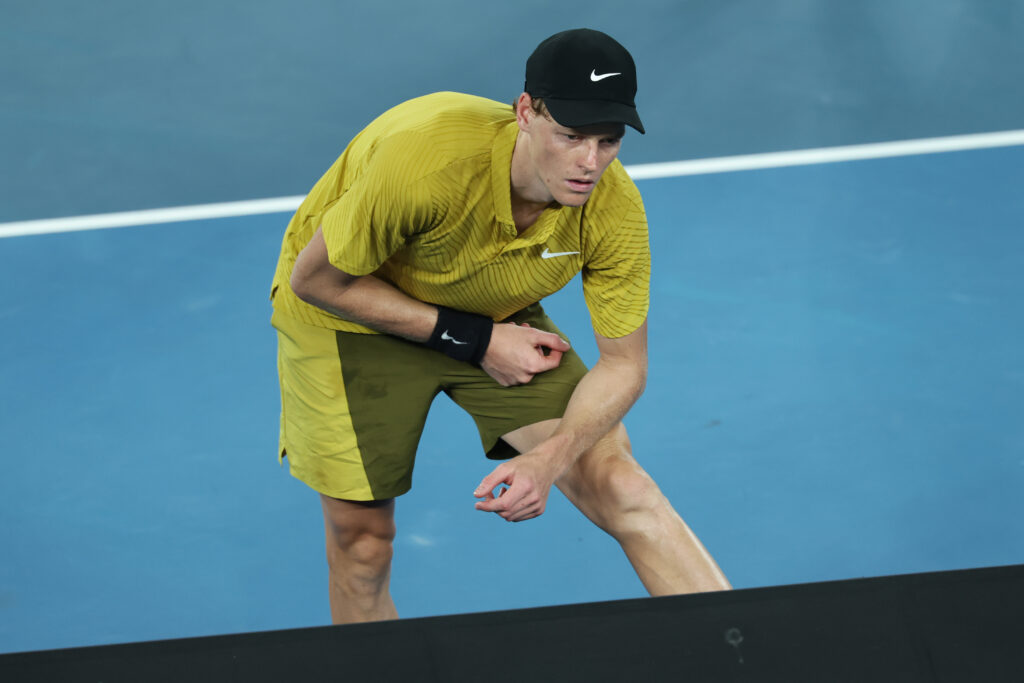
Steve Johnson criticises use of the heat rule at the Australian Open
Every Grand Slam tournament has different rules regarding heat, with the Australian Open monitoring the conditions using its extreme heat policy (EHP) and the heat stress scale (HSS).
The HSS measures external radiant heat, air temperature in the shade, relative humidity and wind speed, and if the scale hits level five then play will be suspended.
Tournament referees can also consult the HSS to decide when to award breaks and close the roof, but only once an even number of games in the set have been played, which was the case in Sinner’s match when Spizzirri was leading 3-1.
When giving his verdict on the incident in Sinner’s match on the Nothing Major Podcast, the aforementioned Johnson called for the Australian Open to make a rule change, suggesting that the heat rule should not be able to take place in the middle of a set.
Were the Australian Open wrong to allow Jannik Sinner time off court when he was cramping?
Despite this, Johnson praised Sinner for how he managed the situation and came back to beat Spizzirri, 4-6 6-3 6-4 6-4.
“I think it’s insane,” said Johnson. “I get why the rule is in place. It’s an arbitrary number that they decided at some point prior to this. I get they are just following rules. I just don’t like that they do it in the middle of the set.
“I get why they come up with the rules and they are going to follow the rules that are in place, but I don’t think they should do it in the middle of sets. They should finish the set. Obviously if it’s rain or something you stop and close the roof but in this instance, I just think they should wait until the end of the set and then close it.
“It’s an outdoor tournament, it is what it is. I get that the rules are in place but the numbers were already set years prior when this whole thing came about. I feel for Elliot. But it’s still pretty impressive the way Sinner is able to manage his emotions and energy levels, and cramping with the arms and legs, and still find a way to get a win.
“He can beat everybody in any given day but when you are not feeling your best and you are certainly physically at one of your lowest points on a tennis court, when you are cramping like that and still get a win, it’s pretty impressive. I just wish they would not close it in the middle of a set.”
Who will win the 2026 Australian Open?
Could the heat rule impact any more of Jannik Sinner’s matches at the Australian Open?
The heat rule is expected to come back into play again at the Australian Open this year, with temperatures predicted to reach 42 degrees Celsius (107.6 degrees Fahrenheit) in Melbourne on Tuesday, January 27.
However, Sinner will be relieved that this is not a day that he will be competing during a match at the Australian Open.
It is still expected to be hot for Sinner for his fourth round match, but if he is able to come through that then it is only forecast to get cooler for the Italian.
| Day Jannik Sinner could play | Forecasted Highest Temperature in Melbourne |
| Fourth Round – January 26 | 31 degrees Celsius/87.8 degrees Fahrenheit |
| Quarterfinal – January 28 | 25 degrees Celsius/77 degrees Fahrenheit |
| Semifinal – January 30 | 30 degrees Celsius/86 degrees Fahrenheit |
| Final – February 1 | 21 degrees Celsius/69.8 degrees Fahrenheit |
This is particularly important for a potential final between Sinner and Carlos Alcaraz, where temperatures are only predicted to get as high as 21 degrees Celsius (69.8 degrees Fahrenheit).
Before he can think about reaching the final, Sinner will have to focus on his fourth round match against his compatriot Luciano Darderi on Monday, January 26.
This first-time meeting between the two Italians will take place in the last match on Margaret Court Arena.
Receive exclusive tennis news and updates twice a week to your mailbox