Roland Garros is an annual tennis tournament often also called the French Open and is one of the sport’s four Grand Slam events, so here is everything that you need to know.
Winning Roland Garros secures a player their spot in tennis history and can count towards a Grand Slam. It is one of just four major events on the ATP and WTA Tours with the Australian Open, Wimbledon and the US Open. Roland Garros also falls as the second major each year.
The best male and female tennis players head to Roland Garros from late May to early June every year to compete for the French Open. It is even tennis’ only major event to be played on a clay court, with Roland Garros providing a unique challenge for any of the competitors.
Tennis greats have even descended on France to play at Roland Garros ever since 1891. The 2025 edition is the 129th running of the tournament, which became a Grand Slam event in 1925. So, with that in mind, here is everything that you need to know about Roland Garros.

Where is Roland Garros? Where is the French Open held?
Roland Garros or as it is often referred to as the French Open earns its nickname as it is held in Paris. The tournament also takes place at the Stade Roland Garros, which is a collection of courts that are located in Paris’ 16th arrondissement, Bois de Boulogne, in the city’s west.
History of Roland Garros
Roland Garros has been the traditional second major event of the tennis schedule each year since 1987. But the tournament itself dates back to 1891 with the first men’s championship. The first women’s championship at Roland Garros did not follow suit until the 1897 edition.
The French Open also closed its doors between 1915 and 1919 due to World War I. But the tournament did take place during WWII. However, the editions between 1941 and 1945 did not receive endorsement by the French Tennis Federation which organises the actual event.
It was also not until 1928 that the French Open found its home at the Stade Roland Garros, to which it earns its predominant name now. Organisers originally took the French Open to the Racing Club de France and to the Stade Francais of Paris in alternative years until 1927.
Early editions of the French Open prior to WWI are not considered toward a player’s Grand Slam record, as well. The tournament was first run as a French club members-only event. It only invited players from the 1925 edition and it did not see a foreign champion until 1927.
Men’s title winners at Roland Garros earn a replica of the Coupe des Mousquetaires, while the women’s champions receive the Coupe Suzanne Lenglen. French Open champions have received the trophies since 1953 but the designs have also been adapted through the years.
La Maison Mellerio, a Parisian jewellers with roots in the 17th century, produces the Roland Garros trophies. Additionally, the Coupe des Mousquetaires became the Musketeers’ Cup in 1981 as it pays tribute to Jean Borotra, Jacques Brugnon, Henri Cochet and Rene Lacoste.
Similarly, the Coupe Suzanne Lenglen earned its current name in 1979 in honour of six-time Roland Garros champion, Suzanna Lenglen. It is almost identical to the trophy that Lenglen received from the City of Nice throughout a dominant period between 1920 through 1926.
Why is Roland Garros played on a clay court?
Roland Garros is the only major tennis event played on a clay court, with Wimbledon going alone with a grass court compared to the Australian Open and US Open taking hard courts.
Clay courts are more common in central European and Latin American countries owing to its superior ability to withstand warmer climates. Yet clay was at first initially used as a practical measure above all else in 1880 to cover grass courts that had started to wilt due to the heat.
Organisers of Roland Garros use a total of five layers totalling nearly 80 centimetres thick for the clay courts. The first layer is made of stones for drainage, followed by at least 30cm of crushed gravel, 7-8cm of clinker (volcanic coal residue), 6-7cm of crushed white limestone and 1-2mm of crushed red brick dust. The last layer is also what gives the courts’ ochre hue.
Roland Garros also opts to go alone with clay courts to provide a unique challenge. The clay surface is slower than grass or hard courts and also changes the way and direction a tennis ball bounces. It can also produce greater spin and encourages top spin, slice and drop shots.
Players who are raised playing on clay courts often enjoy the most success at Roland Garros, as well. But the courts demand a lot of maintenance with organisers sweeping them before, during and after games, as well as watering them after games and intensively in the evening.
Who has won the most Roland Garros titles?
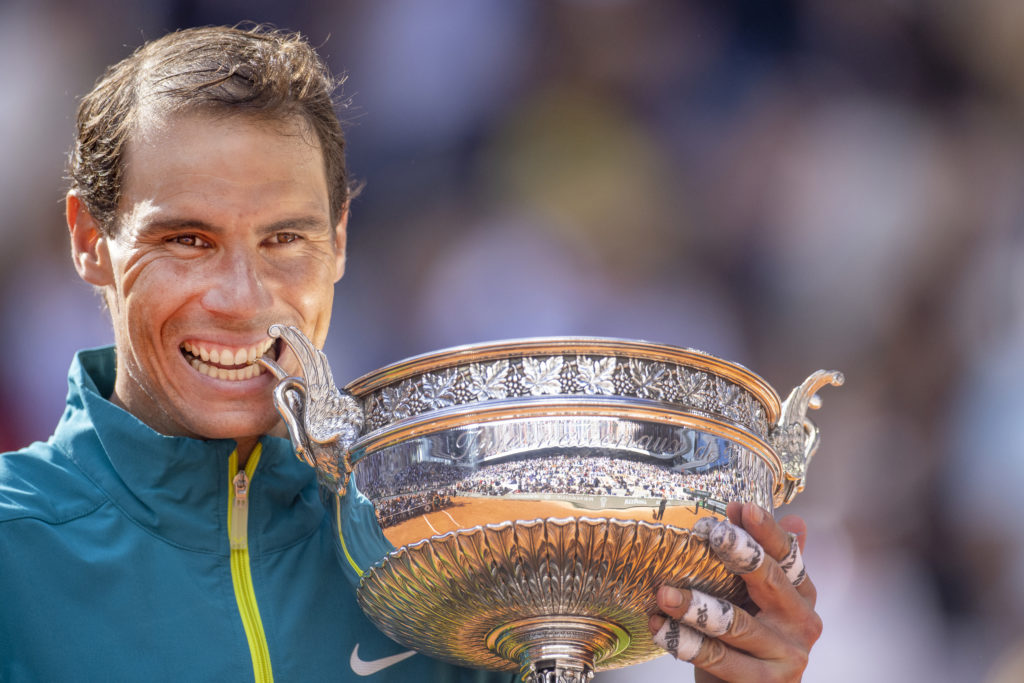
Spanish tennis legend Rafael Nadal has won the most men’s Roland Garros titles in the Open Era with 14. He took the Coupe des Mousquetaires home after winning the French Open in 2005, 2006, 2007, 2008, 2010, 2011, 2012, 2013, 2014, 2017, 2018, 2019, 2020 and 2022.
Henri Cochet, meanwhile, won the most men’s Roland Garros titles in the Amateur Era with four. The Frenchman won in 1926, 1928, 1930 and 1932. Max Decugis also won eight times whilst it was the French Championships between 1903 and 1914 with three dominant runs.
American tennis great Chris Evert has won the most women’s titles at Roland Garros in the Open Era with seven. She won the Coupe Suzanne Lenglen in 1974, 1975, 1979, 1980, 1983, 1985 and 1986. Suzanne Lenglen won the most titles as the French Championships with six.
Who is the youngest person to ever win Roland Garros?
Michael Chang became the youngest person to win a men’s title at Roland Garros to date in 1989. The American won the tournament three months after celebrating his 17th birthday.
Monica Seles also became the youngest person to win a women’s title at Roland Garros thus far in 1990. The Yugoslavian won the tournament at the age of 16 years and six months old.
Who is the oldest person to ever win Roland Garros?
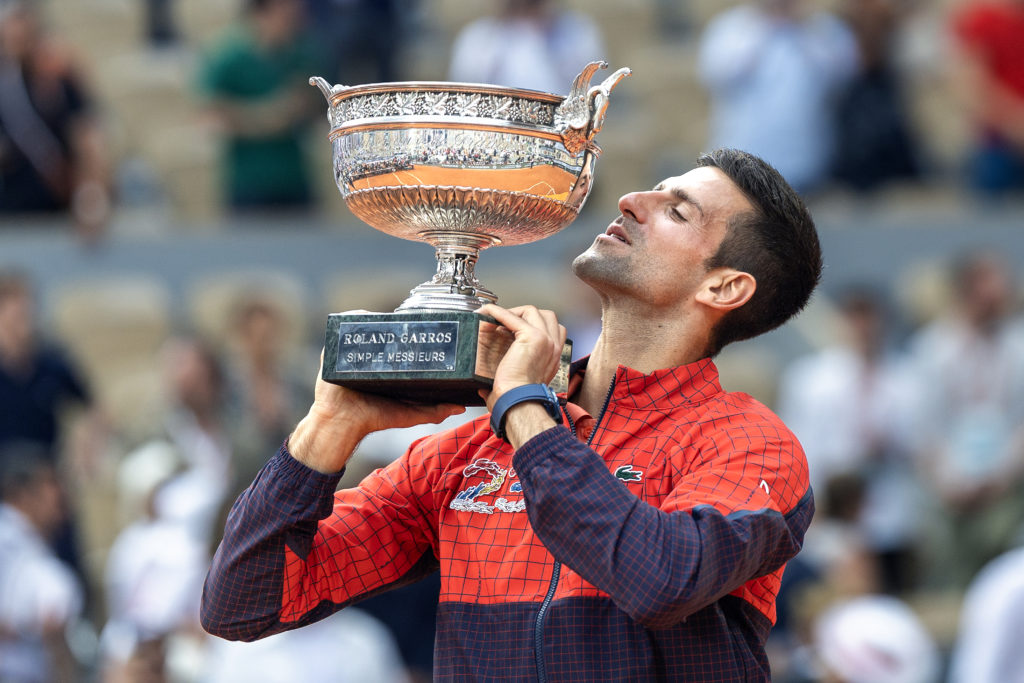
Serbian tennis icon Novak Djokovic became the oldest person to win a men’s title at Roland Garros in 2023. The Grand Slam legend won his third French Open at 36 years and 20 days.
Zsuzsa Kormoczy remains the oldest person to win a women’s title at Roland Garros. She set the record way back in 1958 when the Hungarian won at the age of 33 years and 10 months.
What is the prize money for Roland Garros 2024?
The prize money available for the players at Roland Garros increases year-on-year, with the pool available at the 2024 edition marking an increase of 7.8% on 2023. It stood at €53.5m (£46m) in 2024, but the figure includes the prize money available for all players competing.
The men’s and women’s singles champions each received €2.4m (£2m) and the defeated finalists also made €1.2m (£1m). The championship-winning teams in the men’s doubles and women’s doubles also received €590k (£505k) per team for winning at Roland Garros 2024.
Men’s and women’s singles prize money at Roland Garros 2024
| RESULT | PRIZE MONEY |
| Champion | €2,400,000 (£2,056,716) |
| Finalist | €1,200,000 (£1,028,358) |
| Semi-finals | €650,000 (£556,992) |
| Quarter-finals | €415,000 (£355,618) |
| Round 4 | €250,000 (£214,256) |
| Round 3 | €158,000 (£135,410) |
| Round 2 | €110,000 (£94,273) |
| Round 1 | €73,000 (£62,563) |
Who are the previous men’s singles champions of Roland Garros?
Here is a list of every men’s champion at Roland Garros, including when it was run as the French Championship from 1891 until 1967 and as the French Open from 1968 to today.
1891 – H. Briggs
1892 – Jean Schopfer
1893 – Laurent Riboulet
1894 – Andre Vacherot
1895 – Andre Vacherot
1896 – Andre Vacherot
1897 – Paul Ayme
1898 – Paul Ayme
1899 – Paul Ayme
1900 – Paul Ayme
1901 – Andre Vacherot
1902 – Marcel Vacherot
1903 – Max Decugis
1904 – Max Decugis
1905 – Maurice Germot
1906 – Maurice Germot
1907 – Max Decugis
1908 – Max Decugis
1909 – Max Decugis
1910 – Maurice Germot
1911 – Andre Gobert
1912 – Max Decugis
1913 – Max Decugis
1914 – Max Decugis
1920 – Andre Gobert
1921 – Jean Samazeuilh
1922 – Henri Cochet
1923 – Francois Blanchy
1924 – Jean Borotra
1925 – Rene Lacoste
1926 – Henri Cochet
1927 – Rene Lacoste
1928 – Henri Cochet
1929 – Rene Lacoste
1930 – Henri Cochet
1931 – Jean Borotra
1932 – Henri Cochet
1933 – Jack Crawford
1934 – Gottfried von Cramm
1935 – Fred Perry
1936 – Gottfried von Cramm
1937 – Henner Henkel
1938 – Don Budge
1939 – Don McNeill
1941 – Bernard Destremau
1942 – Bernard Destremau
1943 – Yvon Petra
1944 – Yvon Petra
1945 – Yvon Petra
1946 – Marcel Bernard
1947 – Jozsef Asboth
1948 – Frank Parker
1949 – Frank Parker
1950 – Budge Patty
1951 – Jaroslav Drobny
1952 – Jaroslav Drobny
1953 – Ken Rosewall
1954 – Tony Trabert
1955 – Tony Trabert
1956 – Lew Hoad
1957 – Sven Davidson
1958 – Mervyn Rose
1959 – Nicola Pietrangeli
1960 – Nicola Pietrangeli
1961 – Manuel Santana
1962 – Rod Laver
1963 – Roy Emerson
1964 – Manuel Santana
1965 – Fred Stolle
1966 – Tony Roche
1966 – Roy Emerson
1968 – Ken Rosewall
1969 – Rod Laver
1970 – Jan Kodes
1971 – Jan Kodes
1972 – Andres Gimeno
1973 – Ilie Nastase
1974 – Bjorn Borg
1975 – Bjorn Borg
1976 – Adriano Panatta
1977 – Guillermo Vilas
1978 – Bjorn Borg
1979 – Bjorn Borg
1980 – Bjorn Borg
1981 – Bjorn Borg
1982 – Mats Wilander
1983 – Yannick Noah
1984 – Ivan Lendl
1985 – Mats Wilander
1986 – Ivan Lendl
1987 – Ivan Lendl
1988 – Mats Wilander
1989 – Michael Chang
1990 – Andres Gomez
1991 – Jim Courier
1992 – Jim Courier
1993 – Sergi Bruguera
1994 – Sergi Bruguera
1995 – Thomas Muster
1996 – Yevgeny Kafelnikov
1997 – Gustavo Kuerten
1998 – Carlos Moya
1999 – Andre Agassi
2000 – Gustavo Kuerten
2001 – Gustavo Kuerten
2002 – Albert Costa
2003 – Juan Carlos Ferrero
2004 – Gaston Gaudio
2005 – Rafael Nadal
2006 – Rafael Nadal
2007 – Rafael Nadal
2008 – Rafael Nadal
2009 – Roger Federer
2010 – Rafael Nadal
2011 – Rafael Nadal
2012 – Rafael Nadal
2013 – Rafael Nadal
2014 – Rafael Nadal
2015 – Stan Wawrinka
2016 – Novak Djokovic
2017 – Rafael Nadal
2018 – Rafael Nadal
2019 – Rafael Nadal
2020 – Rafael Nadal
2021 – Novak Djokovic
2022 – Rafael Nadal
2023 – Novak Djokovic
2024 – Carlos Alcaraz
Who are the previous women’s singles champions of Roland Garros?
Here is a list of every women’s champion at Roland Garros, including when it was run as the French Championship from 1897 until 1967 and as the French Open from 1968 to today.
1897 – Adine Masson
1898 – Adine Masson
1899 – Adine Masson
1900 – Yvonne Prevost
1901 – Suzanne Girod
1902 – Adine Masson
1903 – Adine Masson
1904 – Kate Gillou
1905 – Kate Gillou
1906 – Kate Gillou-Fenwick
1907 – Comtesse de Kermel
1908 – Kate Gillou-Fenwick
1909 – Jeanne Matthey
1910 – Jeanne Matthey
1911 – Jeanne Matthey
1912 – Jeanne Matthey
1913 – Marguerite Broquedis
1914 – Marguerite Broquedis
1920 – Suzanne Lenglen
1921 – Suzanne Lenglen
1922 – Suzanne Lenglen
1923 – Suzanne Lenglen
1924 – Julie Vlasto
1925 – Suzanne Lenglen
1926 – Suzanne Lenglen
1927 – Kea Bouman
1928 – Helen Wills Moody
1929 – Helen Wills Moody
1930 – Helen Wills Moody
1931 – Cilly Aussem
1932 – Helen Wills Moody
1933 – Margaret Scriven Vivian
1934 – Margaret Scriven Vivian
1935 – Hilde Krahwinkel Sperling
1936 – Hilde Krahwinkel Sperling
1937 – Hilde Krahwinkel Sperling
1938 – Simonne Mathieu
1939 – Simonne Mathieu
1941 – Alice Weiwers
1942 – Alice Weiwers
1943 – Simone Iribarne Lafargue
1944 – Raymonde Jones Veber
1945 – Lolette Payot
1946 – Margaret Osborne duPont
1947 – Patricia Canning Todd
1948 – Nelly Adamson Landry
1949 – Margaret Osborne duPont
1950 – Doris Hart
1951 – Shirley Fry
1952 – Doris Hart
1953 – Maureen Connolly
1954 – Maureen Connolly
1955 – Angela Mortimer
1956 – Althea Gibson
1957- Shirley Bloomer
1958 – Zsuzsa Kormoczy
1959 – Christine Truman – Zsuzsa Kormoczy
1960 – Darlene Hard
1961 – Ann Haydon
1962 – Margaret Court
1963 – Lesley Turner
1964 – Margaret Court
1965 – Lesley Turner
1966 – Ann Haydon Jones
1967 – Francoise Durr
1968 – Nancy Richey
1969 – Margaret Court
1970 – Margaret Court
1971 – Evonne Goolagong
1972 – Billie Jean King
1973 – Margaret Court
1974 – Chris Evert
1975 – Chris Evert
1976 – Sue Barker
1977 – Mima Jausovec
1978 – Virginia Ruzici
1979 – Chris Evert
1980 – Chris Evert
1981 – Hana Mandlikova
1982 – Martina Navratilova
1983 – Chris Evert
1984 – Martina Navratilova
1985 – Chris Evert
1986 – Chris Evert
1987 – Steffi Graf
1988 – Steffi Graf
1989 – Arantxa Sanchez Vicario
1990 – Monica Seles
1991 – Monica Seles
1992 – Monica Seles
1993 – Steffi Graf
1994 – Arantxa Sanchez Vicario
1995 – Steffi Graf
1996 – Steffi Graf
1997 – Iva Majoli
1998 – Arantxa Sanchez Vicario
1999 – Steffi Graf
2000 – Mary Pierce
2001 – Jennifer Capriati
2002 – Serena Williams
2003 – Justine Henin
2004 – Anastasia Myskina
2005 – Justine Henin
2006 – Justine Henin
2007 – Justine Henin
2008 – Ana Ivanovic
2009 – Svetlana Kuznetsova
2010 – Francesca Schiavone
2011- Li Na
2012 – Maria Sharapova
2013 – Serena Williams
2014 – Maria Sharapova
2015 – Serena Williams
2016 – Garbine Muguruza
2017 – Jeļena Ostapenko
2018 – Simona Halep
2019 – Ashleigh Barty
2020 – Iga Swiatek
2021 – Barbora Krejcukova
2022 – Iga Swiatek
2023 – Iga Swiatek
2024 – Iga Swiatek
Receive exclusive tennis news and updates twice a week to your mailbox