
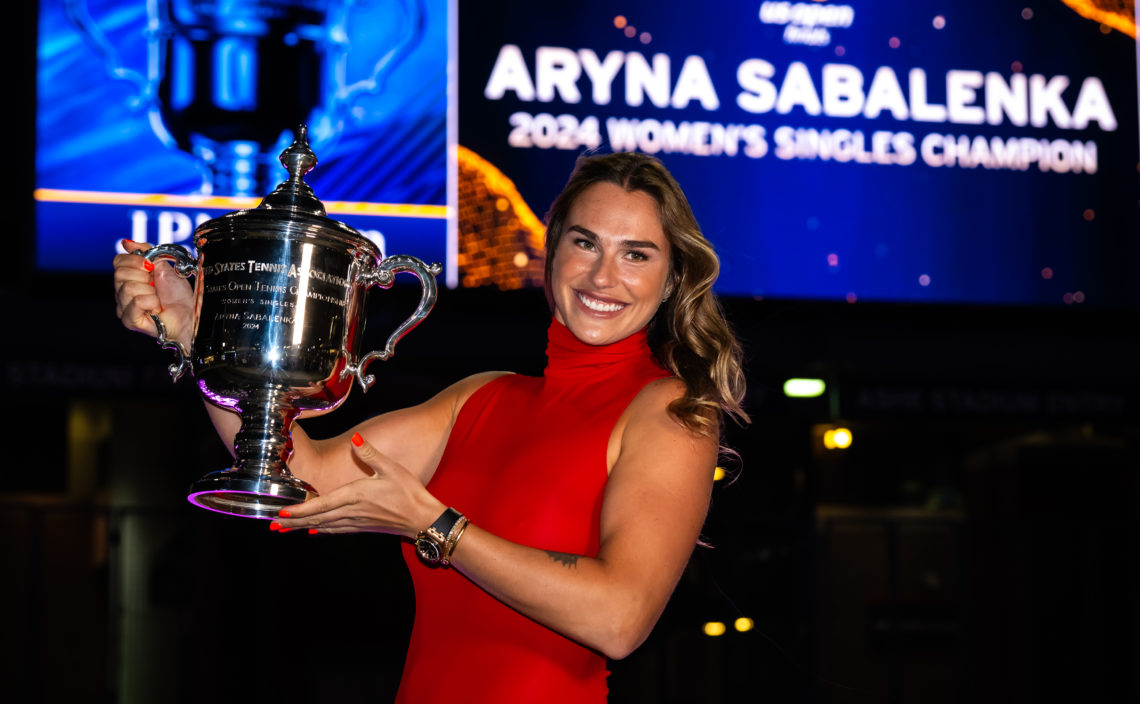

Aryna Sabalenka muscled past Jessica Pegula in a tantalizing two sets to secure her first US Open title.
While Aryna Sabalenka has cemented her status at the top of the sport, her most threatening opponent has historically been herself.
Just 12 months ago, Sabalenka stormed to a set lead over Coco Gauff, before the gutsy American fought back to destroy the Belarusian’s hopes.
At one point, it looked like Jessica Pegula might be plotting a similar trophy heist when she reeled off five straight games to take herself within a game of levelling things up in this year’s US Open final.
However, the flustered Sabalenka of old was promptly dismissed and the Belarusian took the following four to establish herself as the WTA’s best hard court player.

Rennae Stubbs criticises Aryna Sabalenka’s forehand after US Open win
With a bruising forehand being the final nail in the coffin for Pegula, Sabalenka’s ruthless strokes were rightly praised.
Having clocked the fastest average forehand speed of the whole US Open field, including the likes of Jannik Sinner and Carlos Alcaraz, pundit Rennae Stubbs actually had a different view.
In a review of the women’s US Open final, the former doubles player suggested that her forehand side remains her “weakest” shot.
“Honestly it’s funny that you say that,” she said in response to praise of Sabalenka’s shot-making, “Because we’ve been saying how hard she hits the forehand. But honestly, the forehand is her weakest shot of all the shots in her repertoire.
“Her serve is so enormously big and important and Jessica was making a great job of getting it back in the court and forcing Sabalenka to actually hit more balls than she was comfortable doing last night. But the forehand was on, the backhand was on.”
Sorry Rennae Stubbs but the statistics don’t agree!
Stubbs is right to point out that Pegula’s return game was remarkably impressive, with the American having clearly worked on her first ball since her defeat to Sabalenka in the Cincinnati final.
However, while the Australian pundit admitted that both Sabalenka’s shots were really firing, the final saw her hit the majority of winners on her forehand, with the most total errors coming from the backhand wing.
This was also the case in Sabalenka’s fourth round, quarter-final, and semi-final matches, begging the question – what is Stubbs basing this take off?
The huge forehand can certainly sometimes feel a bit too huge, however with such a high winner count compared to an average error count, perhaps it’s not her ‘weakest’ shot after all.
Receive exclusive tennis news and updates twice a week to your mailbox